

On paper, someone in the UK could decide to become an estate agent tomorrow and begin operating. Of course, the reality is far more complicated, but the point being made is that whilst every other profession involved in the homebuying process (the broker, the conveyancer, the surveyor and so on) must undertake years of study, regulated exams or professional accreditations, estate agency remains the outlier, not requiring a licence to practice or any kind of formal qualification. Now, when you consider how essential the role of the agent is in the homebuying and selling process and the fact that the agent is dealing with assets worth hundreds of thousands, if not millions, of pounds, mandatory qualifications do seem like a fair proposition.
“Among major developed economies, the UK now looks structurally unusual. Most peer nations require some combination of licensing, supervised experience, examinations or continuing professional development before an individual can legally practise as an estate agent.”
-The Voice of the Agent Part 5, 2026
The idea of implementing qualifications for agents has been banded around for a while, but it’s only until recently that it’s started to gain legs. The Conservative government commission the Regulation of Property Agents (RoPA) chaired by Lord Best in 2018, recommending mandatory training and qualifications for agents. Labour has since picked up the baton. The Ministry of Housing, Communities and Local Government’s (MHCLG’s) consultation on the Home Buying and Selling Reform outlined its plans to introduce not only mandatory qualifications but also a professional code for property agents.
The aim is to drive up standards, speed up transactions, reduce fall throughs and improve trust. One thing is for sure: this is a major shakeup of the industry.
There are many voices in the industry supporting the proposals, including RICS, Propertymark, The Conveyancing Association and the general public. How do proposed mandatory qualifications sit with you?
Let’s go through the pros and cons of these proposals to uncover what this may mean for the industry.
The Pros
Higher standards across the industry
Agents are lightly regulated compared to other industries. Sure, we have the Estate Agents Act 1979 and The Property Ombudsman, but without mandatory qualification, there isn’t a level playing field amongst operating agents.
The lack of regulation means there is a risk that a small proportion of agents may make errors or operate below acceptable professional standards. This can:
- Erode trust
- Cause delays
- Result in mispriced properties
- Cause financial loss for buyers and sellers’
- Create more work for conveyancers.
If estate agents had to be qualified, consumers would gain greater confidence that they are operating to a recognised professional standard, helping to stamp out bad practice and filter out rogue operators. Ultimately, inconsistent standards can undermine trust and damage the reputation of the industry as a whole.
Trust is a major challenge for agents. The Ipsos MORI Veracity Index 2025 shows that only 32% of people express trust in estate agency as a profession, and this is down 5% year on year.
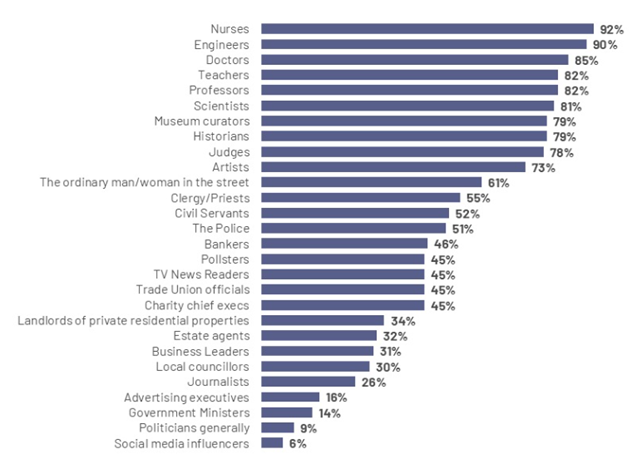
Ipsos MORI Veracity Index 2025
Qualifications and a code of practice could help raise the status of the industry and rebuild trust in the homebuying process. It would establish estate agency as a more highly respected profession and help address some of the negative perceptions held by the public.
According to an Open Property Data Association survey, 66% of buyers say they would never move again after a poor experience. Though this is, by no means, the agents’ fault, and instead a collective failing of the entire process, the frustration is palpable. Introducing these proposals would give consumers greater confidence and consistency throughout the transaction.
Qualifications help establish a level playing field. At present, some agents have worked their way up through years of experience and hard-earned progression, while others may be just starting out. How is the vendor to distinguish between levels of capability? The MHCLG’s proposals aim to introduce consistency, with everyone held to the same standards of knowledge and ethics.
It could allow agents to raise fees
According to an article in Estate Agent Today, 70% of homeowners believe agents should hold formal qualifications, and around half of homemovers surveyed by Rightmove said they would be willing to pay more for qualified agents. That’s welcome news for the industry, particularly when UK agents are operating on comparatively slim margins. Rightmove found that the average fee earned by UK agents stands at just 1.3%, compared with average fees of between 3.5% and 4.5% in France, 5.44% in the US and 5.95%–7.14% in Germany.
Fewer delays and fall throughs
Transactions currently take, on average, 211 days, and around 1 in 4 properties fall through. Failed transactions are costing the UK economy £2 billion annually. If we have fully trained agents, we should in practice see a drop in overpricing, fewer administrative errors and better transaction management. All of this will help to speed up transactions and reduce fall throughs.
Professionalising property agents
The profession is almost like the ‘wild west’, where anyone can set up an estate agency without prior training. By professionalising agents, the role becomes more appealing, attracting new talent.
Many agents are on board too. Research from GetAgent found 65% of agents supported mandatory qualifications and 72% felt it would improve public trust. This shows clear support from peers for the propositions.
The Cons
Costs
A new regulatory body and mandatory qualifications don’t come free. Agencies would likely face additional expenses for compliance, training and licensing. For smaller firms in particular, the cost of implementation could be a significant concern, as well as the time required to get staff qualified. Some may shut down as a result. This could give larger agencies the opportunity to dominate further.
While some of these costs may ultimately be passed on to consumers, there is also a risk that higher fees could make some agents less competitive and potentially lead to a loss of instructions in an already margin-sensitive market.
Potential staff shortages
Though there is support from many agents, for others this is very much a contentious proposal. Many experienced agents may take umbrage at being told that the role they have been performing for years will now require formal qualifications. Imagine a 60-year-old veteran agent sitting the same exam alongside a younger rookie agent? It feels like a kick in the teeth to experienced, self-taught agents who have been doing the role for years. Those closer to retirement could throw in the towel altogether, and the industry loses all that valuable experience.
Qualifications can also act as a barrier to entry for new agents and startups. This could reduce the pool of potential future talent coming through
Tick box qualifications
Arguably, much of the role of the agent is learnt on the job, and stripes are earnt over the years. Can you realistically learn sales skills through an exam? Can a qualification teach you empathy or resilience? Does a licence suddenly make you a king at negotiations? For many, estate agency is seen as a career you can enter and progress based on performance rather than qualifications. Someone may perform poorly in exams, but on the ground, be a fantastic agent. The idea is to improve competency; the fear is that this will become simply just a tick boxing exercise that doesn’t take into account real-world competence.
The argument that it will reduce rogue agents also doesn’t hold true. Other industries that are highly regulated still have rogue actors. A qualification doesn’t guarantee integrity.
Implementation will be tricky
The existing proposals on how to approach the matter open up many questions, such as: what happens to experienced agents? What if an agent fails? Who will regulate agents? Will all staff, including directors, require a qualification? Will mistakes result in licence revocation?
For now, it’s all very much in the air, and this does create some unease in the industry. Some agents, though, are getting ahead of any mandatory legislation. Demand for Rightmove’s Certificate for Estate and Letting Agents has soared 128% in just a year, and Propertymark reported a 51% increase in demand for its range of qualifications since 2020. So, the appetite to gain qualifications is there.
Final thoughts
The direction of travel is clear. Regulation will happen. Scotland and Wales have already moved toward licensing and training frameworks for lettings agents. Sales agents will be next. England and Northern Ireland will also need to follow suit.
The role of the estate agent demands a broad mix of skills and attributes. This, coupled with overseeing the sale of someone’s largest asset, means it makes sense that a qualification exists as the vendor needs competent guidance. However, we don’t want to lose all the talent that we have. Qualifications may be fine for those new agents coming through, but it’s understandably an unsettling proposition for the experienced agent.
In other countries, you can’t legally operate without passing a licensing exam to ensure that agents have a clear grounding in contracts, compliance, and client safeguarding before they’re involved in any transactions. When we compare with the conveyancer, who is not only heavily regulated but must be qualified, yet earns far less than the agent, qualifications do seem like a fair proposal. How it will be implemented and the backlash that will ensue remains to be seen.