
The landlord exodus shows little sign of slowing. We recently reported that the UK is losing 505 rental properties every day in 2026 to-date. In Q3 2026, that figure climbed to 562 per day, with around 50,600 properties leaving the sector over the quarter. That's up from 495 per day in Q3 2025 and more than three times the rate seen in 2020, when just 167 properties per day exited the PRS.
In 2024, 111,696 properties left the private rental market and in 2025 this figure was close to 181,000. Decade-wide, we have lost 834,800 properties, which equates to nearly one in every six rental properties. Nationwide, this stat is 18.6% of rental stock and 14.2% in London.
Yet, despite so many landlords bowing out of the sector, rental stock is on the rise. And this is a question our analysts get asked regularly. If so many landlords are leaving the sector, why is rental stock rising?
Let’s first look at supply stats. In year-to-date 2026, supply of properties to let has risen by 118,100 properties in the last year. This is 13.6% higher than in 2025 and actually the highest stock level we have observed in the last seven years.
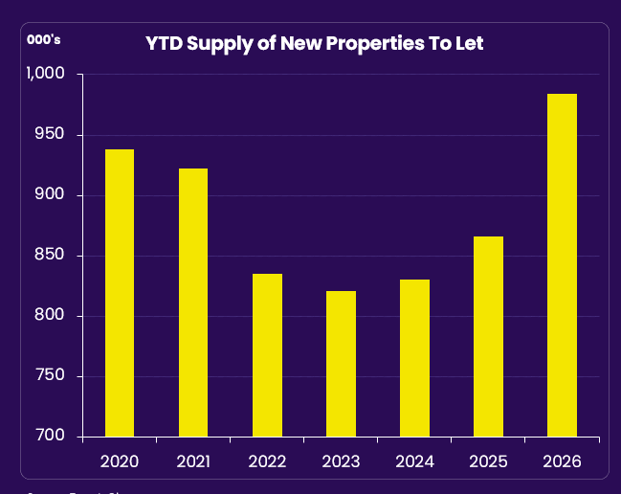
In the year-to-date, we’re seeing supply increasing with double-digit percentage growth in all price brackets. The strongest growth is in the £0-£800pcm price bracket, up 14.5% and the £800-£1,500pcm price band, up 16.0%. The only UK region that hasn’t seen rental stock rise is Northern Ireland. Wales is experiencing the highest supply growth year on year at 26.8%. Inner London experienced the smallest increase, but still at a healthy 8.8% rise. The rest of the UK saw over 10% growth. This is great news for tenants as there is less upward pressure on rents and they have more choice.
So, what is driving the rise in rental stock?
Build to Rent
One of the key reasons behind this increase in supply can be attributed to Build to Rent (BTR) stock now being heavily advertised on mainstream property portals. We’re seeing a 22% year on year increase of directly advertised BTR stock nationally, rising to 34% for London. Historically, BTR operators developed a direct-to-renter route and would rely on their own websites or direct marketing. As they tend to own the whole development, it made sense to market the development rather than individual listings and control the whole customer journey. Now, however, these operators are leaning more on Rightmove, Zoopla and OnTheMarket to advertise in order to reach a much larger pool of renters.
The BTR market is growing. The British Property Federation revealed that the largest supply of BTR is in London with 104,025 units, with 159,498 units outside of the capital. Many UK residents are priced out of buying a home. BTR developments offer a modern, professionally managed alternative with premium on-site amenities like gym facilities, workspaces, and concierge services. Blending convenience with a strong sense of community, these often-sustainable homes are highly attractive to young professionals and growing families alike.
BTR is posing a real shift in the housing market. As small landlords sell up, rental supply is increasingly coming from BTR. Typically owned by investors, institutions or large landlords, BTR is helping to consolidate and professionalise the rental sector. This is broadly the direction the Government wants the PRS to move in, with a more professionalised rental sector intended to drive up standards and provide greater protection for tenants. Magnate Assets claims seven in ten UK investors are planning BTR allocations. The Common Wealth Think Tank states that the BTR sector constructs one in five new homes, increasing to 30% of new homes in London.
The smaller or accidental landlords are running scared of the Renters’ Rights Act (RRA) regulations, whereas BTR operators are better placed to absorb the additional compliance requirements.
Other factors
The RRA has put an end to fixed-term tenancies and converted these to periodic tenancies. Tenants can now give up to two months’ notice to leave. This could mean more tenant turnover, with properties coming back onto the market sooner than they might have under the previous fixed-term arrangements. This could be contributing to more properties being re-advertised, although we must consider that it is still very early days since the implementation of the RRA.
Strong rental price growth in some areas could be attracting more landlords back into the sector. Wales saw the strongest rental price growth at 13.9%, followed by the West Midlands (6.8%) and East Midlands (4.3%). Scotland (1.9%), the South East (1.0%) and Inner London (0.4%) also saw rental price growth. However, it must be noted that rental prices vary starkly by region. In other areas of the UK, rental prices are actually falling. The East of England recorded the largest annual fall, with prices down 7.7%, followed by Yorkshire and the Humber (-4.0%), the North West (-2.4%), Outer London (-2.3%), the North East (-1.6%) and the South West (-0.4%).
“The fallout from the implementation of the Renters’ Rights Act shows no sign of abating. Landlords continue to abandon the buy-to-let market in droves because regulatory and economic pressures mean business is no longer viable. What is really interesting is that despite this huge shift, stock availability for renters is actually rising. The build-to-rent sector [rental newbuilds] is delivering new homes to rent at volume, and other factors are likely playing a part too. For example, larger, professional landlords who can weather the storm better will be looking for investment opportunities and restructuring their portfolios, and with fixed term tenancies abolished under the act, existing properties are re-entering the market more frequently as tenants move on more quickly.”
Colin Bradshaw, CEO
Conclusion
So, why is rental stock rising if more landlords are leaving?
The answer appears to be a shift in the rental market. While smaller and accidental landlords continue to sell up, professional landlords are buying multiple properties, particularly cheaper stock, while institutionally funded new build rental homes are also adding to supply, contributing to a 13.6% rise in rental stock.
We will continue to monitor this trend with interest to see what impact this shift has on demand and rental pricing.