
The Renters’ Rights Act, phase one, is about to land. How prepared are you? Supporting your current landlord clients is more important than ever. There’s also still time to secure new landlord clients who are struggling to navigate the new regulations.
The challenges for landlords created by the Renters’ Rights Act
The abolishment of Section 21 under the Renters’ Rights Act has left many landlords apprehensive. Much of this unease stems from the abolishment of no-fault evictions.
Landlords are also worried about the impact on profits. Under the new rules, rent can only be increased once a year, at market rate, and tenants can challenge any proposed rise at the First Tier Tribunal. Rent adjustments take effect only after the tribunal’s decision, with no backdating allowed. This raises concerns that tenants could routinely challenge increases, delaying higher payments. This is particularly worrisome given the length of current court backlogs. Additionally, bidding wars on new tenancies will be prohibited, as landlords will be unable to accept rents above the advertised amount.
Landlords are also concerned they won’t be able to mitigate risks as effectively because they will no longer be able to request more than one month’s rent in advance. This change is particularly significant for those renting to students, some of whom previously paid upfront (particularly international students who are often required to provide a full year’s rent). The rolling contracts also pose a problem for landlords renting to students. Tenants will only be required to provide two months’ notice, making it extremely difficult to replace students who leave partway through the academic year. Landlords’ options are also being restricted. They cannot sell a property during the first 12 months of a new tenancy.
Ultimately, the new rules are putting landlords on edge. The Act also prohibits discrimination against tenants who receive benefits, have children or own pets. In time, landlords will be required to register themselves and their properties on the Private Rented Sector Database, a compliance and accountability tool. An Ombudsman will also be put in place for tenants to use should they need to escalate issues. The Decent Homes Standard is also being extended to the private rented sector under the Renters’ Rights Act, enforcing a legal minimum standard of housing quality.
Are landlords still exiting in droves?
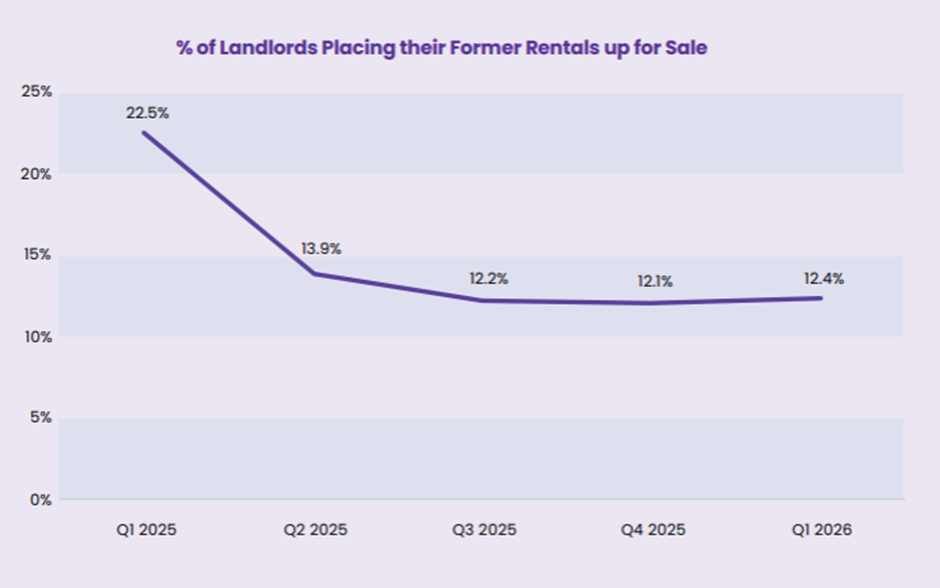
The good news for letting agents is that the landlord exodus we saw occurring has certainly calmed down. In our latest Property and Homemover Report, we found that the number of former rental properties put up for sale in Q1 2026 has almost halved compared to Q1 2025, declining from 22.5% to 12.4%.
The changing role of the letting agent
For letting agents, these new regulations present a clear opportunity. Awareness of the changes remains limited, so there is ample scope for proactive agents to provide reassurance, educate and advise landlords. More self-managed landlords will turn to agents for professional support rather than trying to navigate the changes themselves.
Landlords and letting agents in England must provide tenants with an information sheet before 31st May. It gives tenants information and practical advice on the Renters’ Rights Act. Failure to do so can result in fines of up to £7,000. The letting agent is best placed to act on this rule for the busy landlord.
One thing you need to be discussing with your clients is that the Renters’ Rights Act is designed to make renting more attractive for tenants, not to disadvantage the landlord. The disgruntled are riling up the majority. Put the new rules into perspective. Most tenants simply want a stable home and are unlikely to challenge fair rent increases. Similarly, the abolishment of Section 21 evictions is not catastrophic. The majority of tenants are reliable and cooperative. The Government’s English Private Landlord Survey 2024 also found that the majority of tenancies (83%) are ended by the tenant, not the landlord, anyhow.
As long as tenants are properly vetted and landlords maintain appropriate insurance, there is little cause for concern. Though tougher rules on discrimination will be implemented, landlords still retain the final decision on tenant selection. (Though some fear this could lead landlords to be more selective when choosing tenants.) Rolling contracts should also not be feared - Scotland has successfully operated periodic tenancy agreements since 2017. Most tenants prefer stability regardless. It is your job to reassure your landlord clients. The new regulations are not devastating and can be easily implemented with little disruption.
For landlords who choose to remain in the market, the outlook should be one of positivity. Demand, as measured by Let's Agreed is up 5.8% year on year, so there is a strong pool of tenants seeking accommodation.
Agents who can guide spooked landlords play a crucial role in preventing more landlords from selling up and limiting further strain on rental availability.
How can TwentyEA support letting agents?
Pricing accurately will be essential to avoid any disputes from tenants that may end up at the tribunal. TwentyEA Insight reports can provide you with evidence of the average rental prices in your local area. As the Act only allows one annual rent increase and no bidding is allowed, you need to get the price right the first time. Insight can be used to defend your valuations. You can also use Insight to monitor demand and stock levels in the market to anticipate future rent levels.
Agents can also use our market-leading Automated Valuation Model (AVM), which is embedded in our Search tool, to find out the rental potential of a property. The AVM can be used to research other properties in the area to ensure your pricing is as effective as possible.
If you’re interested in finding out more. Book a demo with the team.