

“I’m out,” exclaimed landlords up and down the country when the abolishment of Section 21 evictions was announced. That was if they hadn’t already hung up their hats off the back of excruciatingly high mortgage costs. The last few years have been tough on the rental sector. A sheer lack of available rental properties pushed letting prices up to an average of £1,450 per calendar month. Affordability and availability have become a nightmare for tenants and would-be tenants.
According to the National Residential Landlords Association, over a quarter (26%) of landlords sold at least one of their properties in late 2024, the highest proportion ever recorded.
There is a silver lining, though, as we reported in our latest Property and Homemover report, that the pace of landlords exiting has slowed. The percentage of landlords placing their former rentals up for sale has fallen from 22.5% in Q1 2025 to 12.4% in Q1 2026, bringing it more in line with the long-term expected average. The surge in landlord exits looks to have passed.
The EPC reforms add further pressure to an already precarious sector, and if not appropriately handled, could lead to a further landlord exodus. Letting Agents must do their utmost to prepare landlords ahead of time to avoid more landlord clients throwing in their towels in the coming years.
What is the EPC reform? Following some back and forth between governments, the January 2026 Warm Homes Plan confirmed a deadline of 1st October 2030 for all privately rented properties in England and Wales to achieve an EPC rating of C. The Scottish Government also proposed that Private Rental Sector (PRS) homes must meet a minimum rating of C from 2028 for new tenancies and 2033 for all lets. At present, Northern Ireland doesn’t have an initiative set up, but it is likely to fall in line if the government want to meet their 2050 net-zero carbon emissions targets.
In The Alto Agency Trends Report 2026, 50% of agents flagged EPC changes as a key concern:
“Many agents are struggling to get clear answers from landlords, especially when upgrades come with significant cost or disruption. For agents, the challenge lies not just in understanding the rules, but in tracking every property and prompting action early enough to avoid noncompliance.”
It’s little wonder that letting agents are concerned - the reform creates a real risk of losing landlord clients. The high costs of property upgrades could push more landlords out of the market.
The current cap on spending on energy efficiency improvements is £10,000 per property. A landlord with a hefty portfolio could be looking at significant spend. Even landlords with more modest portfolios will be hit hard. Savills reported that landlord income and profits are already low (Q2 2025 Lettings Spotlight, drawing on 2022-23 HMRC data). The average private individual landlord reported a gross income of £17,665, which equates to £9,021 profit. A £10k spend per property sees that average profit evaporate. Landlords with old stock are particularly vulnerable.
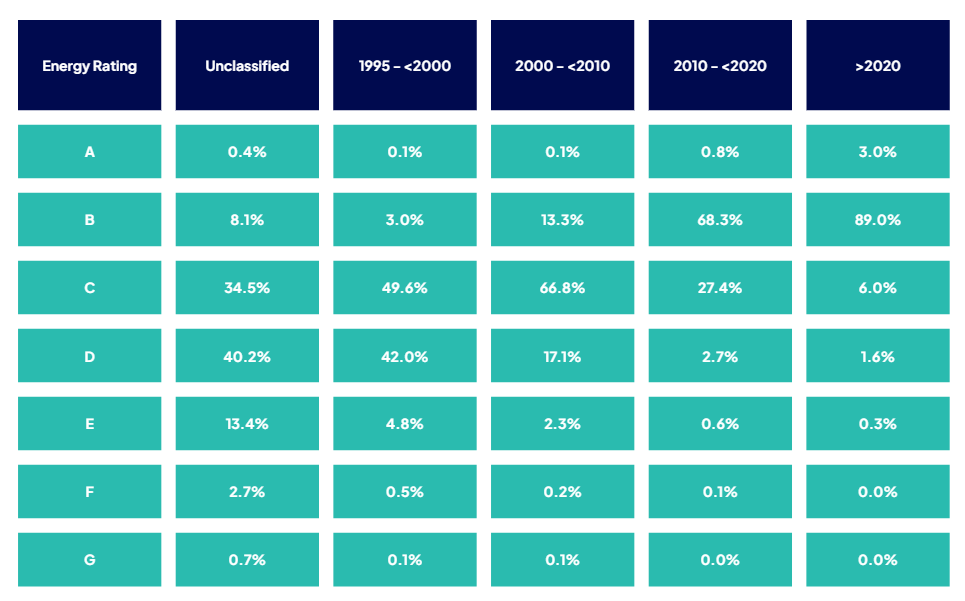
We analysed EPC ratings by property age between 1995 and 2026. The results show a clear pattern:
- Only 1.9% of homes built after 2020 are rated D or below.
- For properties built between 2010 and 2020, this rises slightly to 3.4%.
- Homes built between 2000 and 2010 see a sharper increase, with 19.7% rated D or below.
- For those built between 1995 and 2000, the figure jumps to 47.4%.
The trend is unmistakable - the older the property, the more likely it is to fall short of future EPC requirements, meaning landlords with ageing stock will face the greatest upgrade pressures.
Letting agents are also concerned about how hard it will be to find tenants for sub-C properties. The crisis in the Middle East is creating anxiety around rising energy prices. According to research in Letting Agent Today, 82% of British tenants and owners are concerned that the tensions could lead to rising oil, gas and fuel prices.
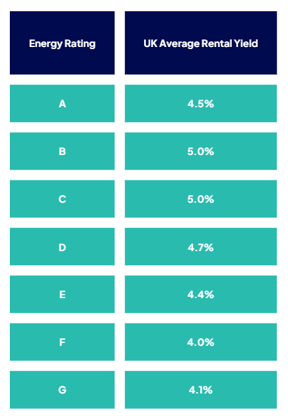
Energy‑efficient homes are becoming increasingly attractive to renters, as lower running costs make them more desirable and can justify higher rents. Our analysis shows that properties with EPC ratings B and C achieve the strongest rental yields at around 5%. While A‑rated homes come in slightly lower at 4.5%, the overall pattern is clear: the better the energy efficiency, the stronger the rental yield.
Why are the EPC reforms a business opportunity for letting agents?
With concern comes opportunity. There’s a significant knowledge gap among PRS landlords. A survey by The Mortgage Works last year found that 62% of landlords were unaware that having an EPC is a legal requirement, and just 33% knew rental properties in England and Wales must achieve a minimum rating of C by 2030. The letting agent who acts as the expert, the educator and the informer is well placed to win new landlord clients and retain old ones. Particularly since the survey revealed that 55% expressed the need for guidance on cost-effective property upgrades, and 53% want clarity on new energy-efficient standards. There’s a clear need for letting agents to step up and support landlords through these EPC reforms.
Letting agents need to prove their value fast. The EPC reforms, coupled with the Renters’ Rights Act legislation, make the landlord more vulnerable than ever. DIY landlords may now be overwhelmed by the increasing regulation. In Rightmove's 2025 Greener Homes Report, 27% of landlords surveyed cite EPC requirements as a growing challenge in managing their properties. Many simply do not understand what’s coming and what it means for them. That uncertainty is your opportunity. Position yourself as the expert guide and turn this confusion into a new revenue stream.
Start with guidance. Raise awareness through webinars, newsletters and social content. Break down the changes, the timelines and the risk. Many landlords are not acting, not because they don’t care, but simply because they lack clarity. It’s up to letting agents to provide that clarity.
Offer practical support:
- Audit all rental properties
- Arrange energy assessments
- Recommend upgrades like insulation, double glazing and boiler improvements
- Connect landlords with trusted contractors (there will be scammers circling, promising quick fixes to landlords. Agents can provide links to reliable and legitimate contractors.)
- Bring structure to the chaos. Help landlords understand what needs to be done and when. This will drive action. Suggest funding opportunities from one of the many schemes currently available (ECO4, the Boiler Upgrade Scheme for heat pumps and local authority grants targeting cold homes).
Not every landlord has a mortgage, so they won’t have lenders guiding them. Agents can step up and be that central point of support. Make it clear that non-compliance could result in significant fines of up to £30,000 per property, being unable to legally let a property or even lenders potentially refusing to finance homes below a C rating. The deadline will come round quicker than landlords anticipate.
As an expert on the EPC reforms, agents can prevent further landlords from exiting out of fear.
How big is this opportunity?
We analysed the national breakdown of properties with a below C rating:
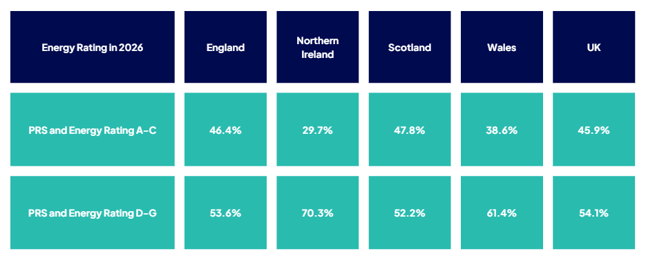
Northern Ireland had the highest proportion at 70.3% of sub-D-rated properties. While the new rules are yet to include Northern Ireland, the government’s net-zero targets suggest they will in time. Wales also has a significant number of properties that fall below C-rated, at 61.4%. Outside of these stats, there are still a further 2.4% of properties that do not hold an EPC certificate, which could also fall below C.
We are seeing the rate of EPC A-C properties improve. When we compare pre-2020 (before the announcement on the EPC rule change) figures with 2026:
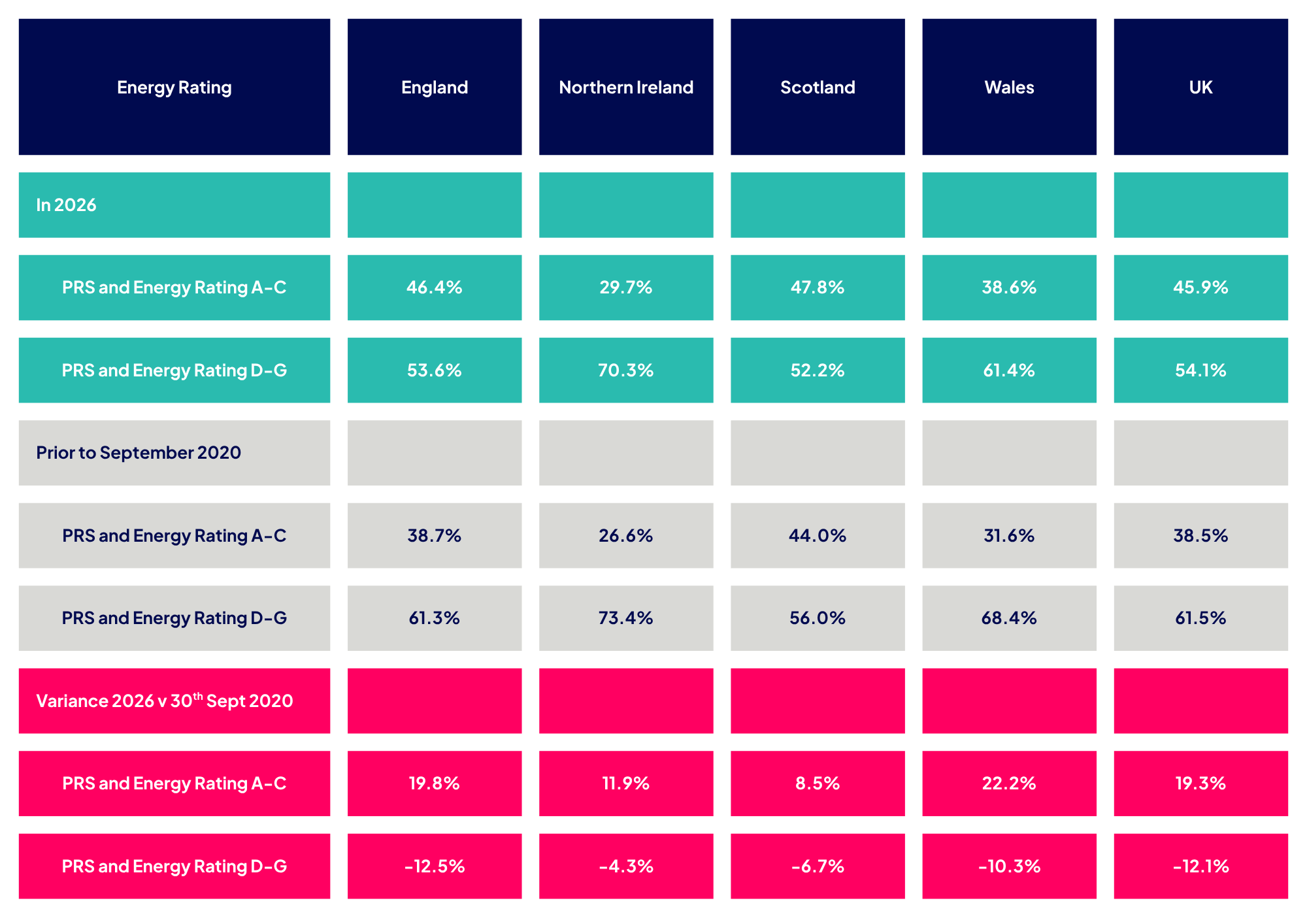
UK-wide, we’ve seen the percentage of EPC rating A-C jump up from 38.5% to 45.9%, with English properties experiencing the largest increase.
With just four years remaining before the deadline and 54.1% of PRS properties below EPC rating C across the UK, any landlords that leave it close to the deadline to retrofit will face a scarcity of labour and materials. The NRLA also raise concerns of a shortage of qualified EPC assessors. It’s up to letting agents to get landlords to act promptly and stress how leaving it until the last minute could spell disaster.
Supporting tenants during property upgrades
For tenants, both agents and landlords need to remember first and foremost that this is the tenant’s home. When improvements are required, these could be highly disruptive to their lives. Letting agents play a critical role in keeping tenants happy, informed and comfortable throughout any energy efficient upgrades.
Communication and transparency will be key. Tenants should be informed well in advance of any works that are planned and be available to answer any questions and alleviate concerns. The agent should be minimising disruption wherever possible and find out if tenants can remain in situ during improvements. Tenants who feel supported tend to stay. That protects rental income and reduces void periods.
The new Home Energy Model (HEM) framework adds further complexity
The planned shift to a new multi-metric system from October 2026 will cause further confusion for landlords. HEM will make EPCs more accurate and more reflective of running costs. This will change the ratings of properties overnight. Rather than A to G ratings, HEM will assess properties across four metrics: energy cost, carbon emissions, energy use intensity and a heating system metric. Under these new metrics, despite how good your insulation is, fossil fuel heating systems will score poorly under the new system. This is going to catch many landlords off guard. HEM is expected to come into effect in 2029 and though EPC certificates will remain valid for ten years, it’s going to have a big impact over the coming years as the old system starts to be phased out.
Final thoughts
The Renters’ Rights Act became the tipping point for many landlords to sell up and ship out. The ones who stayed are faced with high interest rates and tougher energy efficiency rules. Rather than worry that your landlord clients will shut down shop, use the EPC reform as an opportunity to become the expert. Educate and support your landlord clients while attracting new ones, ensuring they are ready to go into 2030 with a fully compliant energy-efficient portfolio of rentals. The deadline is four years away. The agents who act now will be the ones still standing when it arrives.